For metal purchase – all prices & sell directly
V2A or V4A? Stainless steel without laboratory safely distinguish

Two pipe pieces are next to each other. Same diameter, same shine, same cut edge, same weight in the hand. One is V2A, one is V4A — and no look, no magnet, and no scale tells you which one is. From then on, those who accept this sort stainless steel much more reliably, because they check the right characteristics instead of the obvious ones.
The question "V2A or V4A" has an answer, it's just not where most people are looking. This article shows what actually distinguishes, which test proves what, and where the famous magnetic test leads astray.
The difference is a single element
Both are austenitic chrome nickel steels. Both are stainless, both unmagnetic in soft condition, both equally bright.
V2A bear the material number 1.4301 (X5CrNi18-10), also known as Nirosta or by American designation as 304. Around 18 percent chromium, 8 to 10 percent nickel. The close relative 1.4307 is the same with less carbon.
V4A classically carries the material number in Germany 1.4571 (X6CrNiMoTi17-12-2), besides belong 1.4401 and 1.4404 in the same group, American 316 and 316Ti respectively. Around 17 percent chromium, 11 to 13 percent nickel — and an additional 2 to 2.5 percent Molybdenum. Titanium is added as a stabilizer at 1.4571.
This molybdenum is the whole difference. It makes the passive layer resistant to Chlorides, so against salt in any form: salt, sea air, swimming pool air, chlorine-containing cleaning agents, waste water. V2A holds on dry air and in water for decades; in chloride environment it gets perforated corrosion. V4A is standing there in the same place.
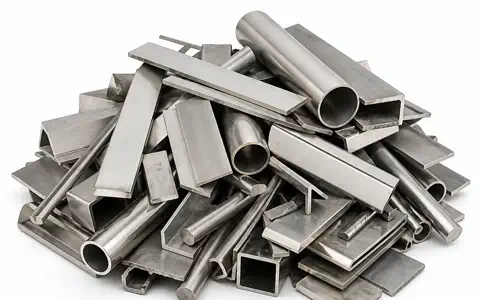
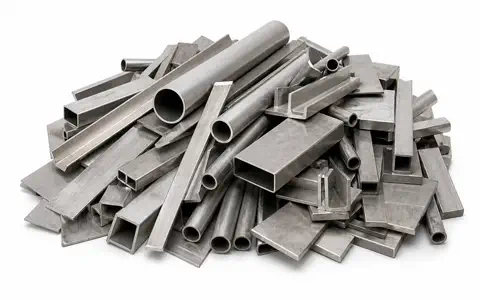
Because molybdenum and the higher nickel content are alloy elements that themselves have a value, lie V2A stainless steel scrap, up to 1.5 m and V4A stainless steel scrap, up to 1.5 m as two separate grades in the price table and not as one.
The magnetic test: the most common misassessment
The sentence "Stainless steel is unmagnetic — and regularly falls on the nose. "
Why cold-deformed V2A becomes magnetic
Austenite is not magnetic, but it is not stable against deformation. Is austenitic stainless steel Cold deformed — towed, bent, edged, deep drawn, rolled, punched, cut, threaded, cut off with the cut-off disc — a part of the austenite changes into deformation martensitate. And this martensite is ferromagnetic.
The result in the container: A V2A sheet, on which the magnet falls in the middle, holds it to the cut edge. A V2A screw holds it on the thread, not the head. A drawn wire, an edged corner, a deep-drawn sink, a pipe arch, a cold-cut disc: everywhere there the display is weakly magnetic, and the material is still V2A.
This is the most common misjudgement of stainless steel — and it goes in both directions. Those who give a slightly magnetic part in the iron scrap quickly give it away. Anyone who excludes from a magnetic edge, it is not stainless steel, sorted out perfectly correct goods.
What the Magnet Really Answers
It's still useful, just for other questions:
- Is it austenitic stainless steel or ferritic? A part that keeps the magnet equally strong on the whole surface, even in the middle of the sheet, is not austenitic. Often it is 1.4016 or 1.4509 — ferritic "stainless steel without nickel, installed in household appliances, decorative blinds, sink borders, fireplace pipes. That's not V2A or V4A.
- Is it stainless steel or chromed steel? Chrome-plated or nickel-plated steel sheet shines similarly, but keeps the magnet bomb-proof everywhere and shows rust at scratches and edges.
- Is there any foreign iron? A powerful magnet, pulled through a box of stainless steel waste, brings out screws, structural steel angles, chip residue and washers. This is the most valuable use of the magnet ever.
What the Magnet not can separate V2A from V4A. Both are austenitic, both react to cold deformation the same. Who is sorted with a magnet, not sorted by V2A and V4A.
What color, weight and sound do not answer
Honesty at this point saves time:
- Colour and shine are identical. Both are light silver grey, both can be polished reflectively, both are supplied matt brushed or blasted. A surface description does not contain any information about the alloy.
- Weight doesn't help. V2A is about 7.9 grams per cubic centimeter, V4A about 8.0. This is not to be separated with kitchen scale and measuring cup. In contrast, the density comparison works excellently against aluminium (2.7), whereas against brass (8.4 to 8.7) it is too scarce.
- The Sound separates stainless steel from aluminium and hardened steel, but not V2A from V4A. Two identical pipes sound the same.
- The fracture area also says nothing about the alloy. Both are tough, both tearing after strong deformation with a matte, fibrous, gray surface and distinct lacing — in contrast to hardened tool steel that breaks glass and without deformation.
- The spark test separates stainless steel from structural steel: Austenitic stainless steel gives a short, dark red to straw-colored, economical beam almost without branchings, structural steel a light yellow-white spray fan with many squares. The difference between V2A and V4A is not readable.
The inscription is the only proof on the part
What really decides is usually written somewhere — just know where to look.
- Tubes and pipes carry very often an elongated or etched print: dimension, standard, material number, melting number. The print often sits only on one side and is partly wiped off with used pipes — turn the tube once around its axis and wipe over it with a cloth.
- Sheet and flat steel carry a stamp or label on the narrow side or on the last sheet of a stack.
- Screws, nuts and discs stainless steel are on the head with A2 or A4 ==References== A2 corresponds to the V2A group, A4 contains molybdenum and corresponds to the V4A group. This is the simplest unique marking in stainless steel, and it stands for millions of parts.
- Armatures, flanges, fittings and pump housings carry the material number cast in or hammered, usually in addition to nominal width and pressure level.
- Papers are the most reliable source: delivery note, inspection certificate, plant documentation, list of spare parts. If you are remodeling from a plant, you will find more there than on any component.
Beware of a case: A material number on a pipe applies to the pipe, not to the welded flange, the holder or the fitting on it.
The location is the strongest indication without papers
If there is no inscription, the origin is the practically best feature. Chloride load costs money, so V4A is installed where it has to be and not otherwise.
Where typically V4A is: Swimming pool and sauna technology, wastewater and sewage treatment plant technology, chemical and plant engineering, tanks and containers for aggressive media, pipelines with chloride-containing media, coastal proximity and everything that sees sea water or sea air, boat fittings, flue gas guides, food and pharmaceutical systems that are driven with chlorine-containing cleaners, fixtures in tunnels and indoor pools, a litter salt environment in the outdoor area.
Where is typically V2A: Internal kitchens and catering, railings and handrails in the interior, facade parts, housings, furniture fittings, sinks, cookware, household appliances, dairy and beverage technology, general mechanical engineering, sanitary installations in the building — what is involved in this sector is at Sanitary.
Two limitations: The location is a clue, not a proof. And in mixed plants both are installed — the pipeline from V4A, the console next to it from V2A.
Hole corrosion as a testimonial
A feature that only used parts have and that reveals a lot: Hole corrosion", called Lochfrass in operation. It shows itself as tiny dark punctures, often with a rust-brown yard around it, preferably on welds, in crevices, under seals, and at places where liquid stops. It's something other than a flight grate, lying on the surface and wiping off.
A part that comes from a chloride-loaded environment and shows hole corrosion is highly likely to be V2A, which was installed in the wrong place. A part of the same environment that has remained blank is highly likely to be V4A. Conversely, a bare surface in the interior proves nothing — there V2A does not rust anyway.
The pit test on molybdenum
There is a chemical evidence that checks exactly what is important: In the trade, pit samples are available which strike on molybdenum and thereby separate V4A from V2A. For it to work, it needs a bare, metallically pure spot — grind it briefly, degreasing it, and do not test on a welding seam because there may be another additional material. Those who regularly separate larger quantities of stainless steel will thus come further than with any optical assessment. For a single sheet in the garage, the effort is too high — then decide where to put it and where to use it.
Chips are a case of their own
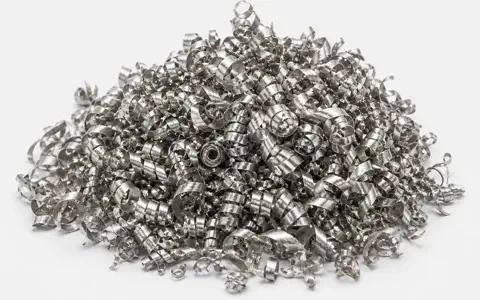
There's two things going on in chips. First, they are completely cold-formed by the cut, so basically a bit magnetic — when sorting chips, the magnet no longer says anything about the alloy, it only pulls out foreign iron. Secondly, everything that the machine has previously chipped is mixed in chips.
For this reason, chips are more stringent than solids: separate, labeled, lockable containers from the first layer. V2A stainless steel turnings are run as their own grade. If V4A chips fall separately, specify this via the Supply In the case of the V2A chips, the V2A chips are not included.
Which lowers the classification
Specifically:
- Foreign iron. Steel screws, galvanized consoles, steel angles, welded feet, steel chains in the same box. The magnetic flow does it.
- Galvanized and chromed partsheld for stainless steel.
- Ferritic stainless steel like 1.4016 between V2A wastes.
- Mixture of V2A and V4A. A mixed container is classified according to the weaker grade — the complete molybdenum advantage is eliminated.
- Mounting parts made of brass, copper and aluminium: fittings, sealing rings, transition pieces, fittings.
- Insulation on pipes. Mineral wool, plastic coat, sheet metal coating, adhesive tape — often more than you think of insulated pipes.
- Gaskets, plastic inserts, rubber feet, glass panes.
- Residues in containers and pipes. Tanks and pipes must be empty, flushed and pressureless.
- Colour, enamel, coating, glued foils.
- Oil and cooling lubricant in chips. Drain, do not pack wet.
- Overlength. The grades are based on waste Up to 1,5 m cut. Longer tubes, profiles and sheets will be lengthened beforehand, then the grade, transport and container will fit together.
What does not hurt: cut edges, grinding marks, start-up colours from the weld seam, rust, traces of use, a matte surface.
Parts that really cannot be classified do not belong to a stainless steel type. For mixed, there are Mixed scrapFor pure steel Iron scrap — both on request, i.e. without daily price in the table.
So the stainless steel comes to us
Submit: up to 1,000 kg per shipment throughout Germany, maximum 31.5 kg per package. The shipping label comes from us by e-mail, per package 6 euros will be charged with the payout. For a bucket of chips or a crate of fittings, this is the easiest way — the process is under Package delivery.
Collection: from 500 kg Germany-wide with own fleet. The collection costs are staggered by distance, are between 40 and 350 euros and are fixed before the trip. This is the usual way for pipelines, containers and rejects from plant engineering.
Deliver yourself: Industriestraße 4, 67063 Ludwigshafen am Rhein, Monday to Saturday 9 a.m. to 6 p.m., without appointment. Companies from the Rhine-Neckar region drive directly to the calibrated scales, while customers from the rest of the federal area are just as right. Further delivery points will follow. How it works on the farm: Delivery.
Choose grade, payout
The first grade is done by selecting the grade at the time of sale. It is calculated according to the actual grade. That is why the quarter of an hour you spend with the flap on the tube print and with a look at the plant documentation is the most effective preparation that exists.
Weighing on calibrated scales, the weighing is yours. Payment is made within 24 hours after receipt of the weighing slip, cash or by bank transfer. The minimum payment is 25 euros, and from 1,000 euros the money laundering law requires an ID card. In the case of commercial delivery, we charge the tax by credit in accordance with § 14 para. 2 VATG; for scrap metal, the beneficiary owes the tax in accordance with § 13b para. 2 no. 7 VATG.
The daily price of both grades shall be: Stainless steel price opposite — there you see the distance that is involved in sorting. The group with all grades is: Stainless steel. For a larger, unclear or mixed amount, describe it about the Supply: Photos of imprints and stamps, origin of parts, approximate quantity.