For metal purchase – all prices & sell directly
Industrial disassembly: process, costs and value accounting
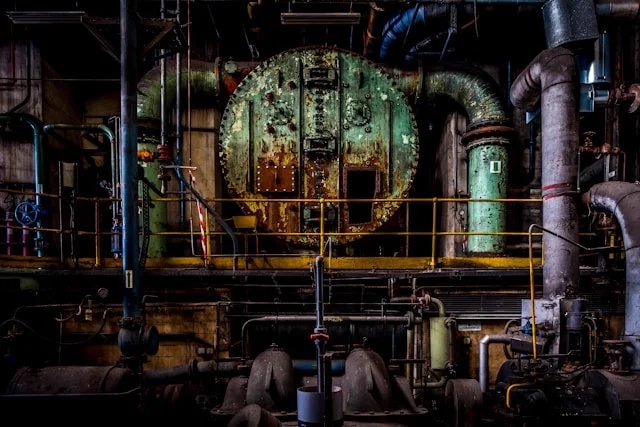
A production line runs out, a hall is drawn empty, insolvency proceedings require the recovery of fixed assets: in all these cases, a Industrial dismantling and with it the question of what the dismantling costs and what the material is worth in the end. The answer surprises many companies: If dismantling is carried out by the metal trade itself, the material value often covers all or part of the costs – in favorable cases a payout remains.
This guide explains how industrial disassembly takes place, which factors determine the cost, how the value calculation works and what evidence you should receive for your documents.
What is part of industrial disassembly?
Industrial disassembly includes the orderly dismantling of technical equipment – from the individual machine to the complete plant:
- Production plants and production lines: Presses, machine tools, conveyors, robot cells
- Boiler, tank and pipeline installations, also made of stainless steel (V2A 1.4301, V4A 1.4571) and special materials
- Hall equipment: crane systems, shelving systems, ventilation and extraction systems, transformer stations
- Steel structures: structures, stages, silos, facades
- Electrical and drive technology: motors, switchgears, cable paths
Important for the demarcation: Disassembly is not a demolition of the building. The building structure remains standing; the technical equipment will be dismantled – including the decomposition before a conversion if necessary.
In six steps from offer to billing
-
Inspection and inventory
At the beginning there is an appointment on site: Which systems are available, which materials are involved, how are the space conditions, which media (electricity, gas, hydraulics) are still connected? A quantity and material estimate is generated from the inventory.
-
Offer with value accounting
On this basis, you will receive an offer that shows both sides of the invoice: the dismantling and logistics costs and the amount of materials charged at daily prices. So you see before commissioning whether the bottom line is costs or a credit.
-
Schedule and security planning
Decommissioning often takes place in ongoing operation. The first cut is preceded by risk assessment, coordination with your safety specialist, activation of the systems and the proven pressurelessness of lines.
-
Disassembly with separation on site
The system is disassembled – in such a way that the materials are already separated during dismantling: copper from windings and collecting rails, stainless steel from containers and pipes, aluminium from profiles, steel from the supporting structure. This varietal purity will later decide on the proceeds.
-
Transport with own fleet
Containers are placed, loaded and driven; weighed on calibrated scales, each transport receives a weighing slip.
-
Settlement and proof
In the end, there is a bill that compares dismantling costs and material revenues – plus the waste disposal evidence for everything that does not go into the metal cycle.
What an industrial disassembly costs
The price cannot be called a lump sum – these factors determine it:
Accessibility
A free standing machine on the ground floor is dismantled faster than a chained system on the third floor without a crane runway.
Material mix
The higher the proportion of copper, stainless steel and aluminium, the higher the material value will bear the costs. Pure steel structures bring less per ton, but much mass.
Harmful and operating materials
Oils, cooling lubricants, artificial mineral fibres or asbestos suspicion require own documented disposal routes and increase the effort.
Date pressure
Decommissioning in ongoing operation with narrow time windows (nights, weekends, holidays) costs more than a free field.
Maintenance value
Machines that can be resold as second-hand goods often bring a multiple of their scrap value – we check this before cutting.
What a Disassembly Cost — An Example Calculator
To make these factors a number, here are two calculated cases. Both are example invoices and no commitment. The plants are designed to make the bill readable – they are not billed projects. We will determine the costs of your installation on site, and only the written offer will be binding after the inspection.
Two approaches have been established beforehand. The material values follow the daily buying-in prices of the 60 grades in eight groups, which also in the Purchase of metal We rate iron and steel scrap on request, here it is set at 0.15 euros per kilogram. And the departure follows the same season as the collection from 500 kilograms: up to 30 km 40 euros, up to 60 km 120 euros, up to 100 km 180 euros, up to 150 km 250 euros, over 350 euros – measured from our factory in Ludwigshafen am Rhein. In case of disassembly, this step is per container journey, not even for the whole project. The rates on the cost side are experience values for an order of magnitude and move with time windows, technology requirements and market situation.
Case 1: production line, 50 tonnes, copper-containing
An expired production line on the ground floor of a hall: presses, conveyor lines, switch cabinets, a transformer station, as well as stainless steel containers and pipelines. Free accessibility, indoor gate at farm level, no running operation, location 85 kilometers away. Total weight about 50 tons.
| Material (share) | Quantity and approach | Total |
|---|---|---|
| Steel scrap: structure, frame, sheet metal (76%) | 38.000 kg at 0.15 €/kg | 5.700 € |
| Stainless steel V2A: containers and pipes (8 %) | 4,000 kg at 0,90 €/kg | 3.600 € |
| Electric motors without attachments (6 %) | 3,000 kg at 0,80 €/kg | 2.400 € |
| Copper: collection rails and cables (7 %) | 3,500 kg at 5,50 €/kg | 19.250 € |
| Aluminium: profiles and housing (3%) | 1,500 kg at 2,30 €/kg | 3.450 € |
| Material value | 50,000 kg | 34.400 € |
| Position and approach | Amount |
|---|---|
| Decomposition column: 4 fitters, 9 working days, 520 € per fitter and day | 18.720 € |
| Crane with operator: 2 days to 1.400 € | 2.800 € |
| Telescopic forklifts and lifting platform: 9 days to 180 € | 1.620 € |
| Cutting technology and consumables | 900 € |
| Transportation: 6 container trips, 85 km, 180 € per journey | 1.080 € |
| Materials: 1,000 kg waste oil and emulsion to 0,90 €/kg | 900 € |
| Risk assessment, protection, project management | 1.400 € |
| Clean transfer of area | 800 € |
| Dismantling and logistics | 28.220 € |
34,400 Euro material value against 28,220 Euro expense: the bottom line in this example remains a Payment of EUR 6,180, around 124 euros per tonne. Weighing is done on calibrated scales, the scales belong to you, and will be paid within 24 hours of weighing.
The result hangs on a single line. The 3,500 kilograms of copper are seven percent of the mass and, at 19,250 euros, bring together more than the remaining 46.5 tons (15,150 euros). If this copper falls into the container as mixed scrap instead of being separated in a grade pure, the same plant will tip from the payout into the additional payment.
Case 2: boiler house with extraction system, 12 tons, third floor
The same bill also goes out differently, and clearly. A boiler house with extraction system, 12 tons, on the third floor without crane lift: each part goes via stairwell and material elevator. The pipes are insulated with artificial mineral fiber, the material is almost pure steel, copper is only contained in control lines and two pump motors. The location is 22 kilometers away, in the middle of the Rhine-Neckar area.
| Material (share) | Quantity and approach | Total |
|---|---|---|
| Steel scrap: boilers, ducts, pipes (87.5%) | 10,500 kg at 0,15 €/kg | 1.575 € |
| Stainless steel V2A: flue gas pipes (10 %) | 1,200 kg at 0,90 €/kg | 1.080 € |
| Mixed copper cable (2,5 %) | 300 kg at 3,10 €/kg | 930 € |
| Material value | 12,000 kg | 3.585 € |
| Position and approach | Amount |
|---|---|
| Disassembly column: 3 fitters, 5 working days, 520 € per fitter and day | 7.800 € |
| Lifting platform and material elevator: 5 days to 220 € | 1.100 € |
| Disposal of artificial mineral fibre: 2.400 kg to 0.35 €/kg | 840 € |
| Materials and water chemistry: 200 kg to 1,20 €/kg | 240 € |
| Transportation: 2 container trips, 22 km, 40 € per journey | 80 € |
| Activation, risk assessment, project management | 1.100 € |
| Clean handover | 400 € |
| Dismantling and logistics | 11.560 € |
3.585 Euro material value against 11.560 Euro effort: Here remains a Supplement of 7,975 Euro, around 665 euros per tonne. Not because the plant would be bad, but because three things come together: almost no copper, every kilogram over a stairwell, and an insulation that needs its own documented disposal route. The short way, on the other hand, hardly helps – 80 Euro transport on 11,560 Euro effort is not the lever.
Between the two cases, there are around EUR 790 per tonne. This is the whole answer to the question, why a price without viewing is not a number, but a range: The same tonnage can mean a payout or a surcharge. Therefore, our offer separates the three lines – dismantling, transport and calculated material value – instead of naming a final amount, whose condition no one can verify.
What the balance is shifting
These six sizes move the result the most. Here they are in the order of their effect, calculated at the two examples above:
- Copper content: the strongest single size. One percentage point more copper in case 1, i.e. 500 kilograms instead of steel, raises the balance by around 2,675 euros. The same goes down.
- Accessibility: free installation at farm level against chained installation without crane runway. Three working days difference for the three-member column from case 2 is 4,680 euros.
- Height: everything that is not at the farm level needs lifting work platform, material elevator or car crane – and above all more manual work when removing.
- Contamination: oils, cooling lubricants, artificial mineral fibres, suspected asbestos. Each separate disposal route is its own position with its own proof; in case 2, 2.4 tons of insulation cost 840 euros and thus consume almost the total copper proceeds of 930 euros.
- Date pressure: Nights, weekends, company holidays and work in the current operation are going through the daily rate of the column – and the column is the largest position in both cases.
- Distance==References==<br> Between 40 and 350 euros per journey; even the six trips over 85 kilometres in case 1 are almost four percent of the effort at 1,080 euros.
Value accounting: why the metal trade is in advantage
If you hire a pure dismantling or assembly company, this will continue to sell the resulting metal itself – the margin remains with the service provider. If the metal trade performs the dismantling, this intermediate step is not taken: The material is evaluated directly at dealer conditions and this evaluation is included in your offer.
Case 1 above shows how much this makes up: the copper carries 19,250 out of 34,400 euros of material value – seven percent of the mass, more than half of the value. Separated from grades, it is worth a multiple of the mixed scrap price, and that's exactly why we separate during dismantling and not only on the farm. The daily prices per grade can be found in our Purchase of metal and on the side Current metal prices.
Safety and Evidence
In the end, two things count for you as your client: that nothing happens and that everything is documented. The standard includes:
- Risk assessment and coordinated safety plan before start
- Evidenced activation of electricity, gas, compressed air and hydraulics
- Disposal of hazardous substances through approved specialist companies, fully documented
- Weighing machine weights for each material removal
- A final statement that compares effort and material value transparently
You will need these documents for accounting, insolvency proceedings for the administrator and conversions often for authorities and insurers.
Special case Dissolution and insolvency
In the case of operational resolutions and insolvencys, the dismantling process is used: What can be sold as a machine, what goes into the material cycle, what has to be disposed of? Here we work with inventory lists, evaluate position for position and take over the complete Project management – a contact person from the first inspection to the clean transfer of the area.
Frequently asked questions about industrial disassembly
Can you pre-estimate the costs?
One order of magnitude yes, one price no. After a description with photos, we will give you the framework in which a project of this kind is based on experience. Only a written offer after the inspection – with dismantling, transport and calculated material value in separate lines – becomes binding. The invoices on this page are examples and do not apply to any concrete project.
How fast can a dismantling start?
After the visit, the offer is usually within a few days. The start is based on your time window – nights, weekends and company holidays are also planned.
Does MKM Metals only work regionally?
We work throughout Germany and are happy to provide you with an offer for your industrial disassembly.
What happens to oils and other operating materials?
They are recorded before dismantling, disposed of via approved specialist companies and documented with evidence.
Must the building be empty?
Nope. Decommissioning in ongoing operation is everyday life – work areas are secured and every step is coordinated with your safety specialist.
You're planning a dismantling? You can contact us directly via the form below – or you can call: +49 176 6577 0862.